
How to Read an Austrian Patent Search Report

Understanding the Austrian Patent Search Report — A Practical Guide by the ATPO
In the patent examination process, examiners may provide detailed comments on the prior art relevant to the submitted claims in either a preliminary decision or a written opinion (search report). The search report classifies the prior art documents related to the claims, indicating:
- The category of each document;
- The corresponding patent literature (accessible via various databases); and
- The specific claims affected by each reference.
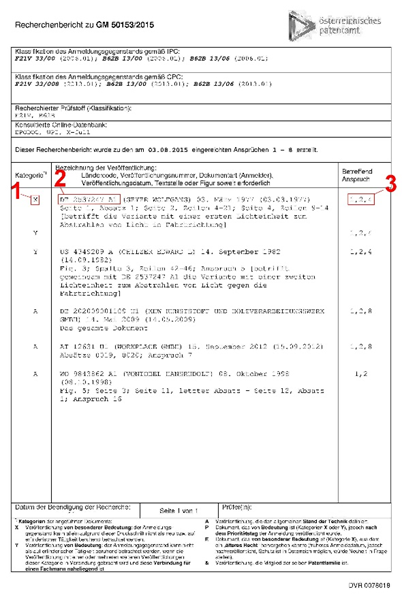
Below is a concise explanation of how to interpret the categories and symbols commonly found in an Austrian patent search report.
Document Categories and Their Meanings
| Document Symbol | Meaning | Explanation |
| X | Highly relevant prior art – the claimed invention lacks novelty or inventive step | The cited document fully anticipates or renders the claimed invention obvious, even if it does not explicitly disclose every technical feature of the claims. |
| Y | Relevant prior art in combination – invention lacks inventive step | The cited document, in connection with one or more other references, makes the invention obvious to a person skilled in the art. At least two documents together must indicate the subject matter. The invention is new but lacks inventive step. |
| A | General prior art reference | The cited document represents background technology that does not conflict with the claimed invention. Nevertheless, the applicant is advised to review it. |
| P | Relevant document (X or Y category) published after the priority date | Example: The applicant filed a patent in Germany on January 2, claiming priority in Austria on September 17. During this period, a “P” document was published on May 15. If this document is identified, the applicant is typically required to submit the priority document (i.e., the initially filed application). If the Austrian and German applications are identical, the document can be disregarded. However, if additional content was added after January 2, the “P” document may destroy novelty or render the invention obvious, since the new features were filed only on September 17. |
| E | Highly relevant document (X category) with an earlier filing date but published later – may constitute a prior right in Austria | Example: The applicant filed an invention on January 6, while another application was filed electronically on January 4 — two days earlier. In such a case, only novelty is assessed, while inventive step is not considered. |
Practical Significance
Understanding the classification of prior art references is crucial for applicants and patent professionals.
- X and Y references identify prior art that may challenge patentability.
- A documents provide useful context for evaluating the technical landscape.
- P and E categories alert applicants to potential conflicts with priority rights or earlier national filings.
The Austrian Patent Office (ATPO) encourages applicants to review search reports carefully to prepare informed responses during examination, ensuring efficient prosecution and stronger patent protection.
(Images sourced from ATPO official website.)