
Empowering Innovative Design: A Guide to Dutch Design Patent Applications

In today’s globalized world, protecting your creative designs is a core necessity for every business and individual. Understanding each country’s requirements for design patent applications is essential. This article introduces the application process for design patents in the Netherlands and outlines available fee reduction measures to help your designs stand out on the international stage.
Authority:
- The Benelux Office for Intellectual Property (BOIP)
Required Documents:
In the Netherlands, design patent applications must be filed with the Benelux Office for Intellectual Property (BOIP). The BOIP conducts only a formality examination to ensure that the design possesses novelty and distinctiveness. The application must include the following documents:
- Representations / Pictures
- Brief description (in Dutch)
- Power of Attorney (scanned copy)
- Priority document (scanned copy) and its Dutch translation
- Statement of ownership / Employment certificate / Priority assignment
SME Voucher Fee Reduction Mechanism:
To encourage small and medium-sized enterprises, the BOIP offers the SME Voucher Program. Through this incentive, companies can receive up to EUR 1,000 in financial support for application fees. Specifically, the voucher provides:
- 75% reduction on EUIPO trademark or design application fees
- 75% reduction on trademark or design application fees in EU member states
- 50% reduction on WIPO international trademark or design registration fees
- Subsidies for other intellectual property–related consultancy services
Design Patents in the Netherlands
In the Netherlands, design patents are filed with the Benelux Office for Intellectual Property (BOIP). The BOIP conducts only a formality examination. A design, as defined by BOIP, refers to the visual features of a product, its lines, contours, colors, shape, texture, materials, or ornamentation. A design must be new and distinctive to qualify for protection.
What Cannot Be Registered in BOIP:
- Designs dictated solely by their technical function.
- Designs that conflict with earlier designs already protected under Community, Benelux, or international design rights before the filing or priority date, even if those earlier rights were published later.
- Designs that include a trademark without the trademark holder’s consent.
- Designs that incorporate copyrighted works without permission.
- Designs that misuse national or international emblems, flags, insignia, abbreviations, or names.
- Designs contrary to public order or morality.
- Designs whose features are unclear in the application.
- Designs of mechanical connectors, which are generally excluded, though components of modular systems—like building blocks of construction toys—may still be protected.
Process & Procedure:
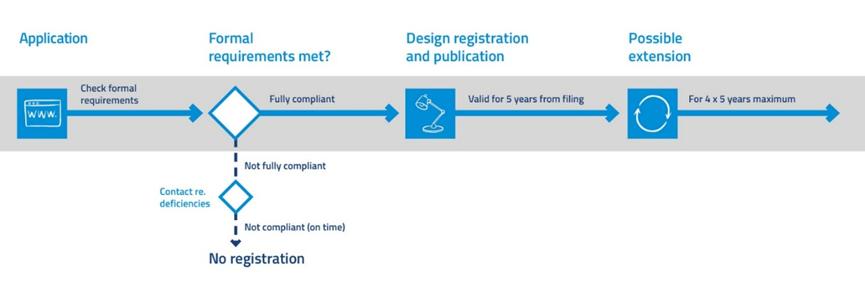
- To pass formal review, an application should include clear images that show the essential features of the design. These images determine whether the design can be protected. Multiple views, such as top, side, or perspective are recommended, and at least one image is mandatory.
- Clearly identify the product the design applies to, using the Locarno Classification.
- State the name of the applicant (individual or company).
- Ensure the design does not violate public decency.
- Designs meeting these requirements are registered and published. Applicants may also request deferred publication, delaying disclosure until the suspension period expires. The applicant may withdraw the deferral at any time.
- Once a design is filed, no modifications are allowed.
Ownership and Disputes:
- If there is a dispute over who owns the design, the actual designer may claim rights within 5 years after registration is published. The designer can also seek invalidation of the design for the same reason.
- There is no time limit for filing a cancellation action. Any action for enforcement or invalidation must be brought before the courts.
- If a potentially infringing design is discovered - registered or unregistered - the right holder may also take the matter to court.
- If infringement is proven, the court can issue an injunction, order damages, or require the surrender of profits and infringing goods, especially in cases of deliberate infringement.
Grace Period for Novelty
A design disclosed to the public within 12 months prior to the filing or priority date may still be protected under a 12-month grace period.
Grant and Renewal Fees
- No grant fee is charged.
- Renewal fees are paid every 5 years, within 12 months before the end of each protection term. Late payment is allowed within a 6-month grace period, but a 50% surcharge applies. The BOIP sends a reminder six months before the renewal deadline.
Average registration time:
- 4 months.
(The image sourced from the official website of the BOIP.)